
Research & methodology
The research behind Cosmos
Cosmos is built on eight years of peer-reviewed research at the University of Bergen, grounded in constructive alignment and the study of curriculum as a connected network. This page sets out that foundation (the theory, where it comes from, and how it runs inside the product) for the academics who want to check our work.
Won by the founding team: the National Education Award (2023).
Last updated September 30, 2026
Programme structure is the highest-leverage intervention
Most quality problems in higher education are structural: coverage gaps, redundant content, misaligned assessment. And structural problems are invisible at the level where universities usually look: one course, one syllabus, one committee at a time. Eight years of research at the University of Bergen led to a different unit of analysis: the programme as a network of outcomes, courses, activities, and assessments.
The research treats a curriculum as an emergent process, not a fixed set of documents: courses, activities, competencies, and topics modelled as nodes and ties, revealing structural roles and interdependencies that no single syllabus review can show.
That position (make the structure visible, then let people act on it) is the whole of the method. Everything Cosmos does follows from it.
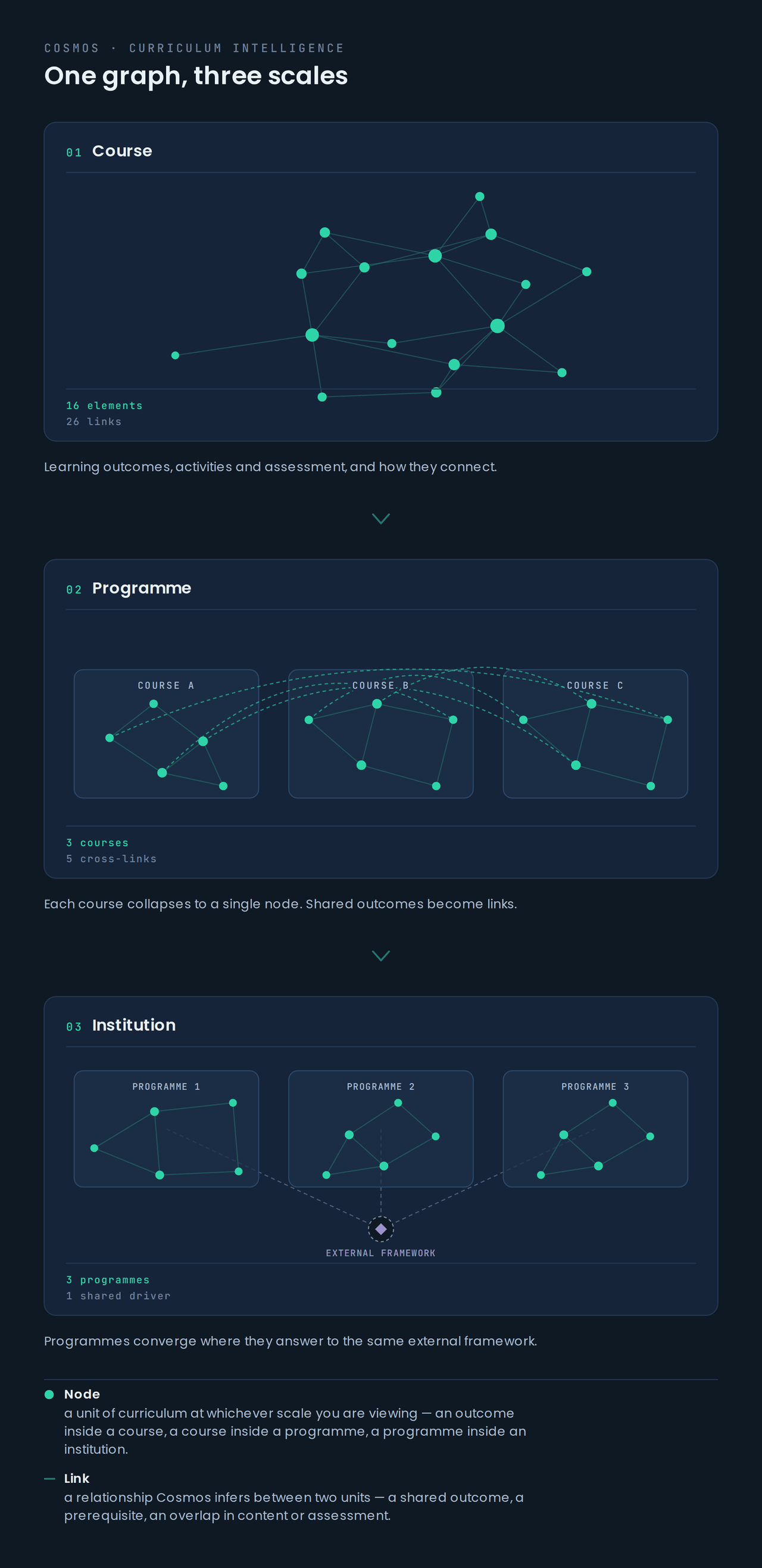
The research spine
Three bodies of research, one method
Cosmos operationalises three strands of peer-reviewed education research. Together they define what the platform measures, and what it deliberately leaves to human judgement.
Learning outcomes, teaching activities, and assessment are read as one connected structure, not three separate lists. This is the foundation of Cosmos's alignment analysis: every activity and assessment is evaluated against the outcomes it is meant to serve.
Courses, activities, competencies, and topics are modelled as nodes and ties. The network view reveals structural roles and interdependencies that no single syllabus review can show.
The point of surfacing structure is agency: when staff and students can see the curriculum's affordances, they can act on it deliberately rather than merely comply with it. This is why Cosmos explains rather than decides.

Origin
Built at the University of Bergen
Cosmos was not built and then justified with research. It came out of the research: eight years of peer-reviewed work on curriculum design and learning analytics at the University of Bergen, now in production at Norwegian universities.
Peer-reviewed, and published
The team's research on educational change and learning design is published in peer-reviewed venues, including lead-authored work in Studies in Higher Education.
Nationally recognised
Members of the founding team were behind the work that won the National Education Award in 2023.
Anchored in the institution
The research programme is rooted at the University of Bergen, including work within the iEarth Centre for Excellence in Education.
The method at work
AI-powered, not AI-dependent
Cosmos does not automate curriculum decisions. The AI is the evaluation engine underneath: doing the reading nobody has time for, and showing its work when it does.

Alignment scored, with the reasoning attached
Cosmos applies constructive alignment as an analysis: it rates how well each activity and assessment connects to learning intentions, and explains every rating in plain language. The methodology requires transparency: an unexplained score would be exactly the black box the research argues against. Your academics see the reasoning, and your academics decide.
See how Cosmos works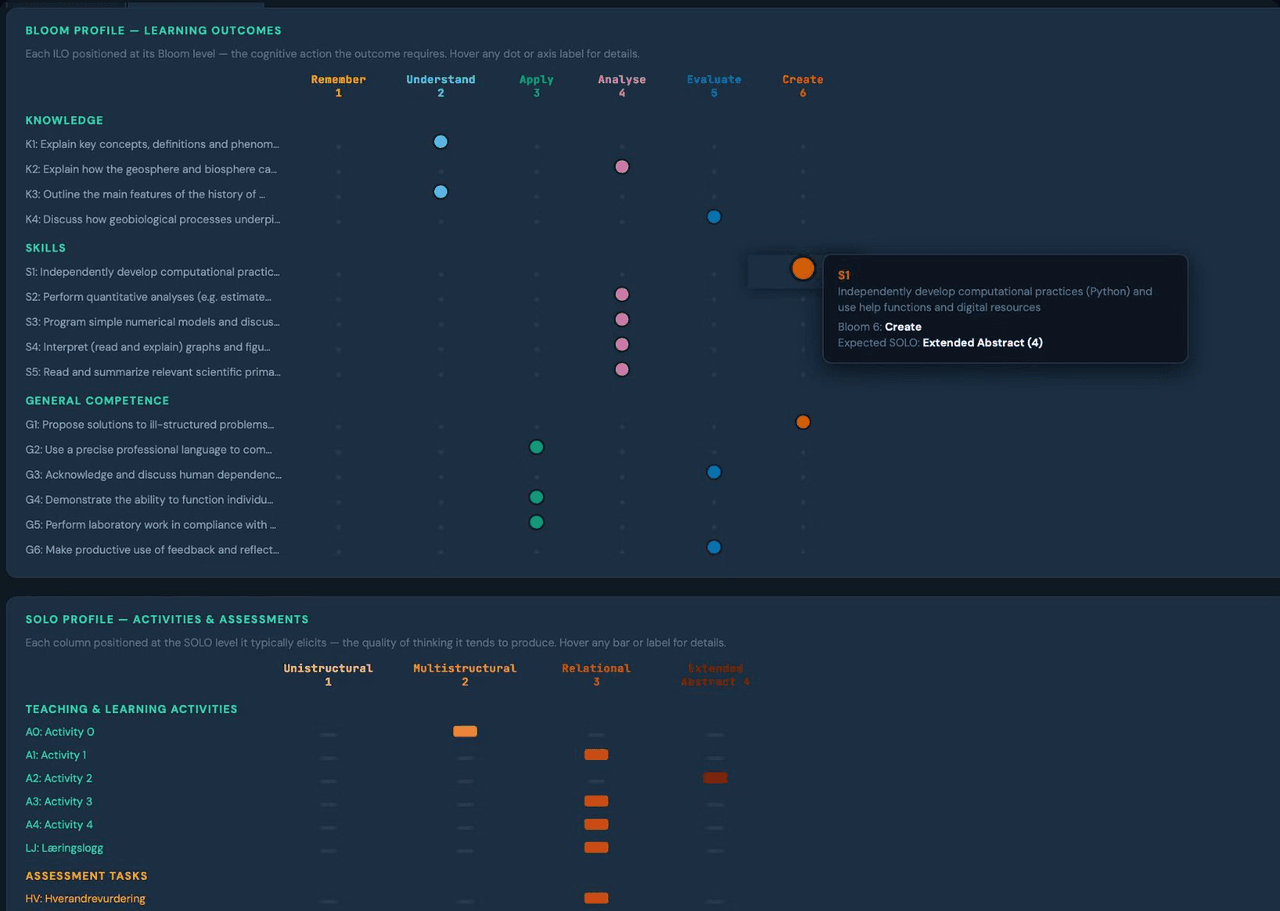
Cognitive demand, tracked across taxonomies
The method is framework-agnostic by design. Cosmos maps the cognitive requirements of outcomes against the demand of activities and assessments using Bloom, SOLO, or the taxonomy your institution already uses; the analysis adapts to your standards, not the other way around.
Explore CosmosRead the research
The method is built on published, citable work. The foundations:
- Biggs (1996) on constructive alignment: outcomes, teaching, and assessment as one designed structure.
- Barnett & Coatte (2005) on curriculum as an emergent, negotiated process.
- Bovill (2021) on student-staff partnership in learning design.
- Ellis & Goodyear (2019) on affordance, agency, and the ecology of learning design.
The Cognosic team's own peer-reviewed research, including lead-authored work in Studies in Higher Education on educational change and learning design, continues at the University of Bergen.
If you want the full publication list, or to talk through the methodology with the researchers themselves, ask us; that conversation is the part we enjoy most.
Questions academics ask about the method
Three strands of peer-reviewed education research: constructive alignment (Biggs, 1996); curriculum as an emergent process (Barnett & Coatte, 2005; Bovill, 2021); and affordance and agency (Ellis & Goodyear, 2019). The method that connects them was developed through eight years of peer-reviewed research at the University of Bergen.
Constructive alignment (Biggs, 1996) means designing learning outcomes, teaching activities, and assessment as one connected whole, so each assessment genuinely tests the outcome it is meant to serve. Cosmos turns that principle into a measurable analysis across a whole programme, scoring how well each activity and assessment connects to the outcomes above it.
Yes. Eight years of published research at the University of Bergen, including lead-authored work in Studies in Higher Education. Members of the founding team were also behind the work that won the National Education Award in 2023.
The AI is the evaluation engine for the constructive-alignment analysis: it scores how activities and assessments connect to outcomes and explains each score in plain language. It applies the framework; it does not make curriculum decisions. That stays with your academics. AI-powered, not AI-dependent.
No. Bloom, SOLO, or your institution's own taxonomy. The analysis adapts to the framework you already use, rather than asking you to adopt a new one.
Want to go deeper than a webpage allows?
Judge the method on your own programmes
Bring a programme you know well. We'll show you what the analysis sees: the alignment, the coverage, and the reasoning behind every score.
A conversation with the researchers who built it (no commitment).