
How Cosmos works
From documents to a living model
Cosmos turns the curriculum information your institution already maintains into a connected, traceable model of courses, learning outcomes, activities and assessment. AI helps structure the information, academic teams validate it, and the resulting model becomes the basis for analysis, scenario planning and quality work.
Under the hood, this connected model is implemented as a curriculum knowledge graph.
Step 1 · Your data
Built to run on the documentation you already have
Cosmos is not a new system for already-stretched staff to maintain. It works from the course descriptions, learning outcomes, and course content your staff has already written, with no new tagging, logging, or data entry for instructors.
Share what already exists
Syllabi and course plans as PDFs, lecture decks, outcome grids, LMS exports; a programme coordinator provides access once. That's the staff effort.
AI proposes a structured draft
Cosmos extracts courses, outcomes, activities, and assessments from the documents and proposes them as a draft model; nothing enters the graph as fact by default.
Faculty review and approve
The draft becomes established only when your academics author or approve it. Starting from scratch instead? Design activities, courses, and outcomes directly in Cosmos.
The relationship is part of the data
A course description can tell you what belongs to one course. A spreadsheet can list many courses. What is harder to preserve is how curriculum elements relate to one another.
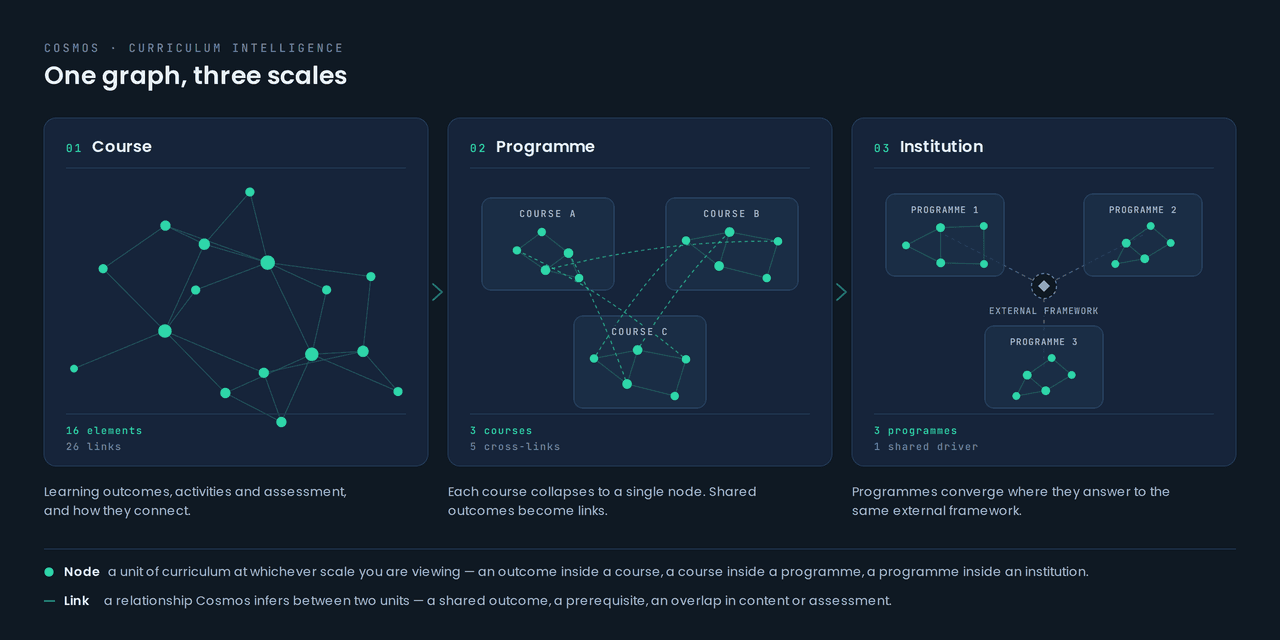
Cosmos represents courses, outcomes, activities, assessments, topics and programme goals as connected elements. Those relationships become explicit and persistent rather than being reconstructed each time someone asks a programme-level question.
This is what allows the same curriculum to be viewed at different scales, from an individual activity to a course, programme or institution, without losing the connections between them.
A curriculum question becomes a query over a connected model, rather than a new manual mapping exercise.
One curriculum, multiple ways to interpret it
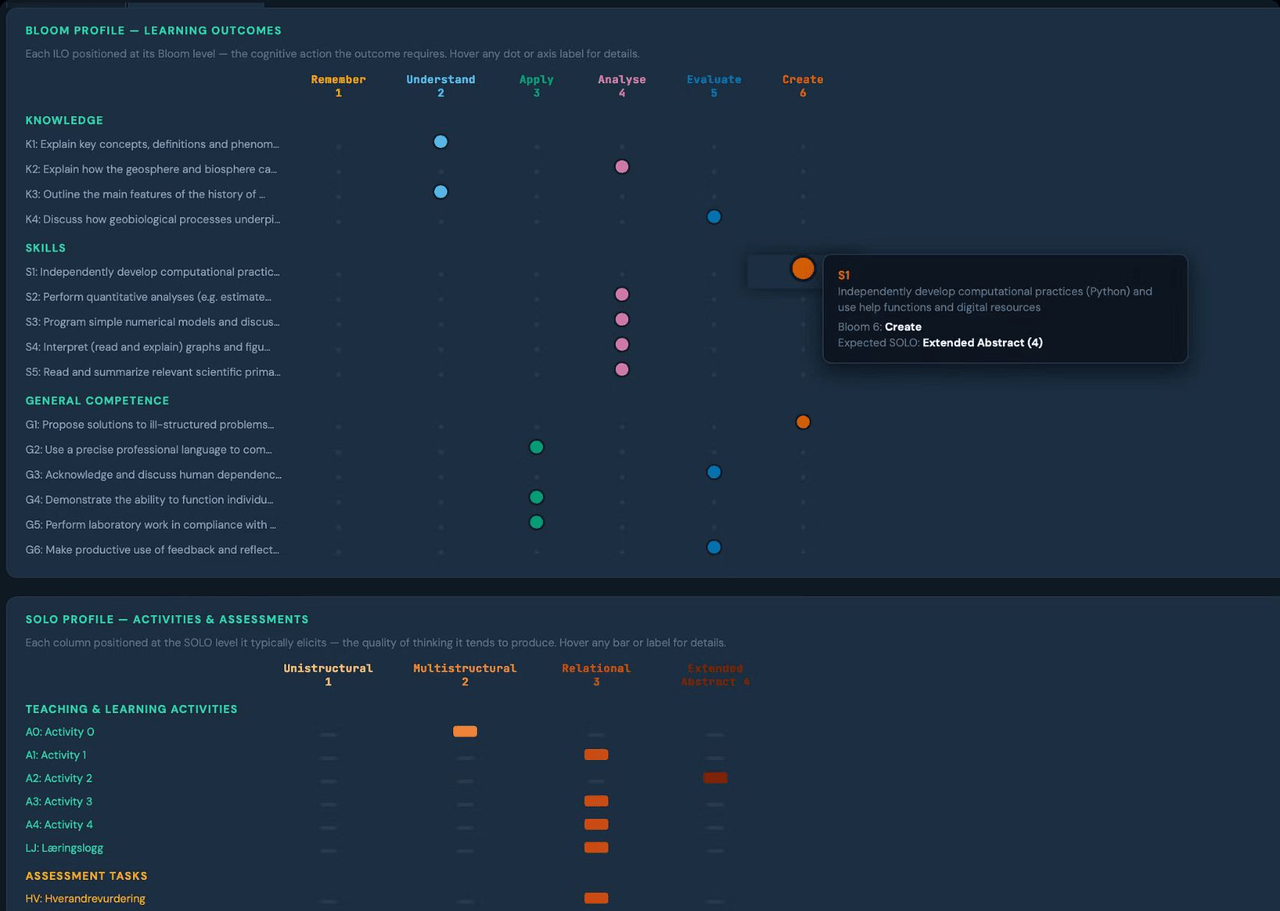
Curriculum elements can be connected to multiple classifications and frameworks without rebuilding the underlying model. That allows the same programme to be examined through Bloom, SOLO, national qualification frameworks, institutional competencies or discipline-specific taxonomies.
The framework adds a lens to the curriculum; it does not replace the curriculum structure underneath.
The same mechanism connects intention to practice: what the outcomes says students will learn, mapped against what teaching activities and assessments ask students to do, tracked across every course element.
Transparent AI
Why not just point AI at the documents?
The honest answer: anyone can stand up a knowledge graph. The difference is what's inside ours: a pedagogically informed ontology, built through eight years of research into how teaching actually connects. Structure is captured once, explicitly; AI helps classify and populate it. The graph, not the AI, is the source of truth.
Step 4 · AI in practice
AI-powered, not AI-dependent
Cosmos doesn't automate curriculum decisions. AI is the evaluation engine underneath: doing the reading nobody has time for, and showing its work when it does. There are no compliance scores and no ranking of teachers: analytics surface the design; your academics decide.

Every score explains itself
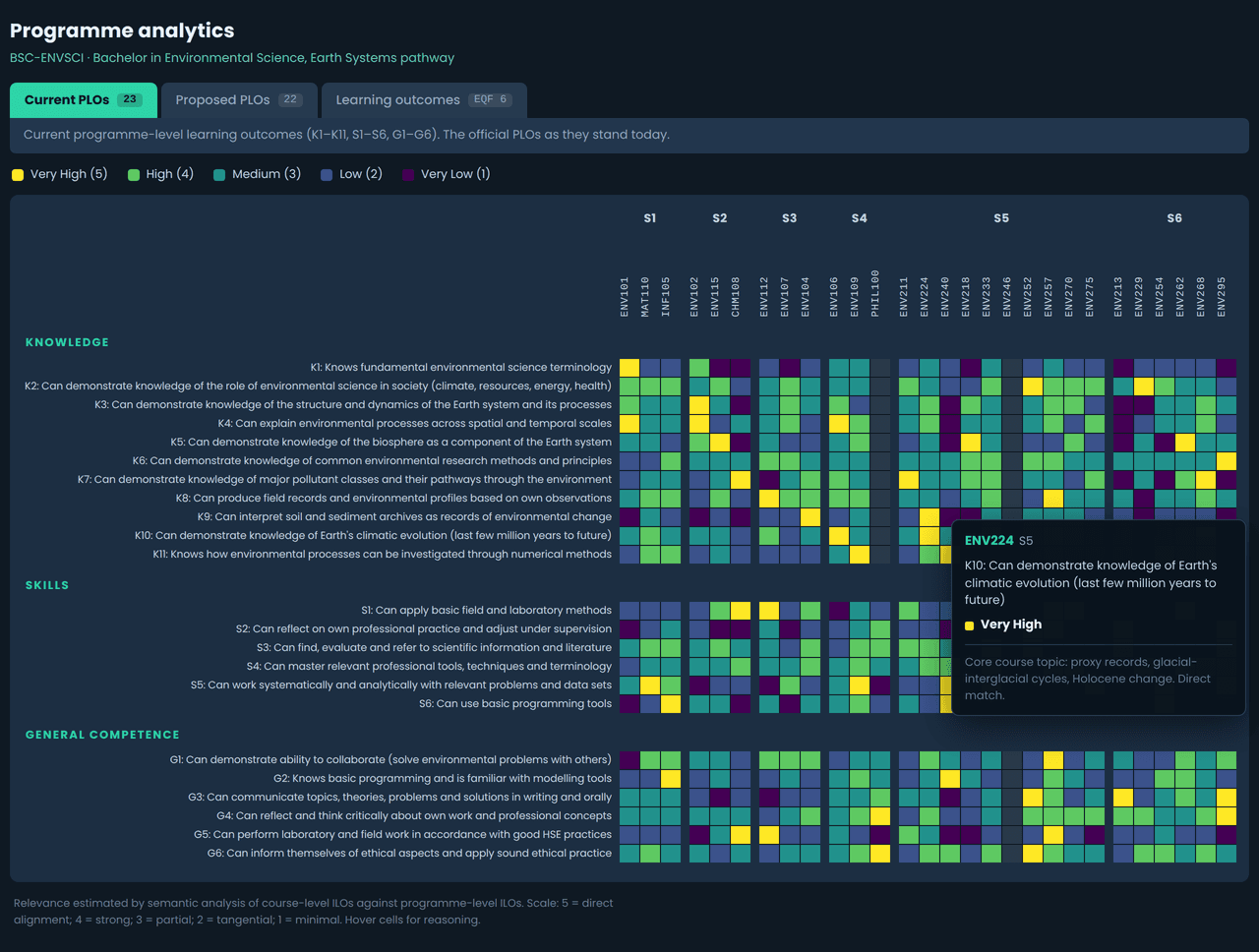
Cosmos rates how well activities and assessments connect to learning intentions, and attaches its reasoning to every score, in plain language. A score is a starting point for curriculum dialogue, not a verdict.
Gaps surfaced at scale
The same scoring runs across entire programmes, not one course at a time. Coverage gaps, overlaps, and thin spots become visible before a review finds them, shown honestly: a gap as a gap, never smoothed over.

Network analytics
Four questions the network can answer
These aren't bespoke tricks. Community detection, centrality, similarity, and pathfinding are standard graph analysis, used on complex systems from biology to finance. Cosmos applies them to curriculum, which no one had structured this way before.
Where are the natural groupings?
Community detection finds the clusters in a curriculum: coherent modules, or silos that should connect.
What's load-bearing?
Centrality surfaces the courses and outcomes everything else depends on: the ones you can't cut without consequences.
What's duplicated?
Similarity finds redundancy: the same case taught in three courses without anyone realising.
Does it build properly?
Pathfinding traces where a skill is introduced, reinforced, and mastered, and where the chain breaks.
Test the change without changing the curriculum
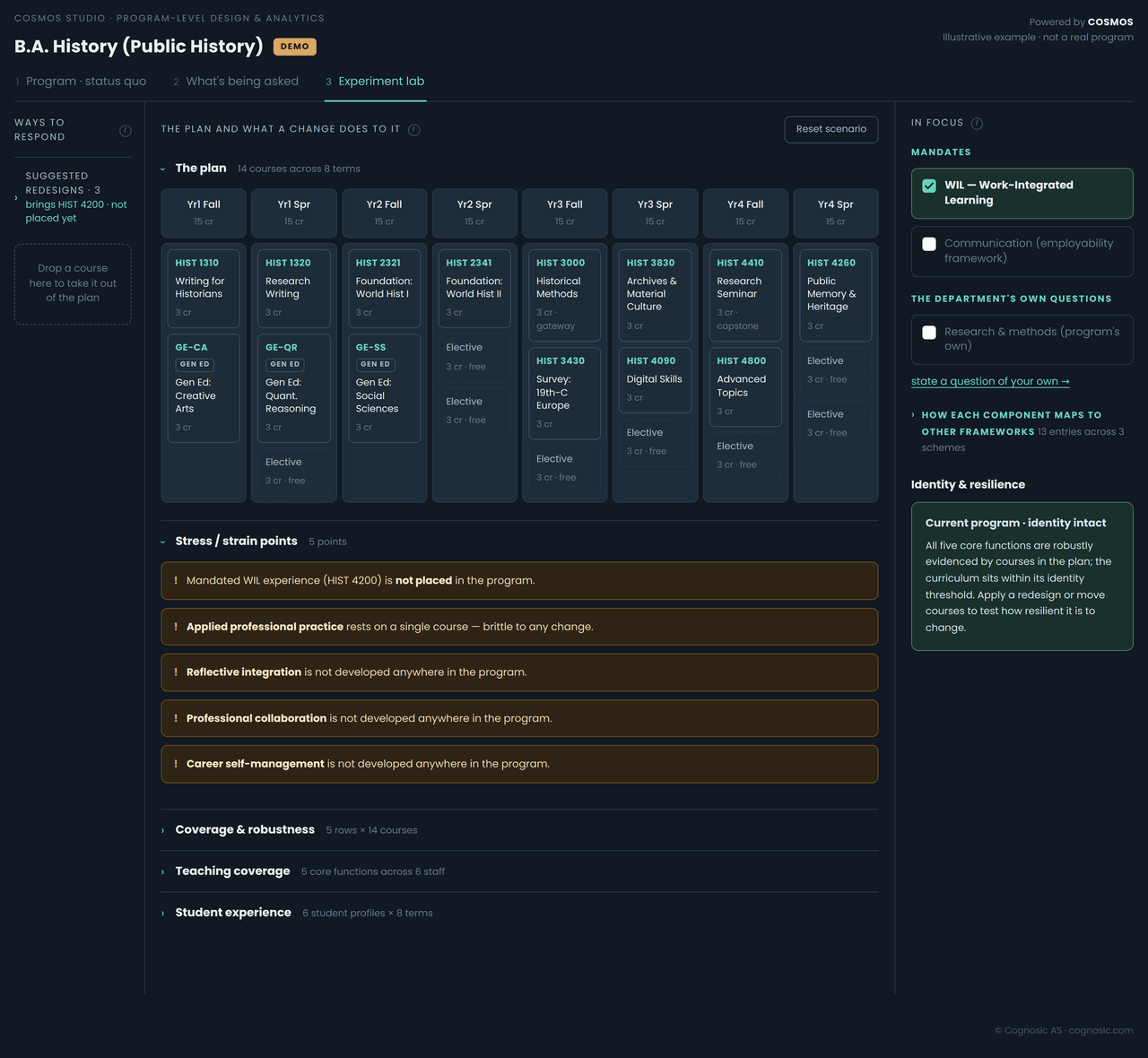
Because Cosmos stores curriculum relationships explicitly, programme teams can create alternative scenarios without overwriting the current programme.
Move a course, redesign an assessment, change a learning outcome, or modify programme structure, then examine how the proposed change affects coverage, progression, alignment, prerequisites, and programme-level goals.
Scenarios can also be evaluated against the requirements the programme is expected to meet, from internal strategies and quality priorities to qualification frameworks, accreditation criteria, and other external mandates.
The current curriculum remains the reference point, allowing alternatives to be compared before implementation.
Evidence is a query, not a project
Because the whole curriculum lives in one connected structure, accreditation evidence isn't assembled; it's extracted. Traceability runs from institutional goals down to individual course activity, and a documented evidence trail is available as a report within a few clicks.
The model stays current the same way: analytics recompute live as the graph changes, so when a teacher adjusts a course, the programme view updates immediately: no re-survey, no export-and-merge. The research calls this a digital twin of the curriculum: the evidence exists continuously, because it's generated by the structure you already work in, not rebuilt by hand in the weeks before a deadline.
Questions about how Cosmos works
Existing course descriptions, learning outcomes, and course content: a one-time coordinator effort to provide access; instructors do no new tagging, logging, or data entry.
See How we work for how a pilot typically runs.
No. The LMS runs courses day to day; Cosmos models the curriculum across them. Today Cosmos imports from LMS exports and documents; it does not write back into the LMS.
No. Imported material arrives as authoritative; AI output arrives as a proposed draft; nothing becomes established until faculty author or approve it. The graph, not the AI, is the source of truth.
Yes. Every score carries its reasoning in plain language. Scores are a starting point for curriculum dialogue, not a verdict; your academics can challenge and override the interpretation.
No. There is no compliance score, no design-completeness percentage, and no ranking of activities or teachers. Analytics surface the design honestly, gaps shown as gaps, and leave the judgement to faculty.
Full alignment with EU/EEA data-protection requirements (GDPR); hosted within institutional/EU infrastructure; no student data leaves institutional control without agreement.
No. Cosmos analyses programme structure, not individual student behaviour or performance.
Still curious how it would work on your programmes?

See it working on a real programme
A demo walks through a live programme: modelled as a network, scored for alignment, with the reasoning behind every score on screen.
Won by the founding team: the National Education Award (2023).