
Built on eight years of research · In universities today
See your curriculum as a living network
Cosmos is the curriculum-intelligence platform for universities, built on eight years of peer-reviewed research and in production at Norwegian universities today.
Made by the team behind the Norwegian national Education Quality Award (2023).

The old way
Curriculum quality, managed by memory
Most universities run programme quality on spreadsheets, PDFs, course catalogues, and the memory of whoever sat on the last committee.
Structure trapped in documents
Outcomes, courses, and assessments live in separate files. Nobody can see the whole programme at once.
Coverage nobody can verify
Which learning outcomes are actually covered, and where they overlap, is guesswork between review cycles.
Evidence rebuilt every cycle
Accreditation evidence is reassembled by hand, every cycle. It takes weeks, and it's out of date the day it's submitted.
Reform that takes years
Programme reform drags on for years, because strategy never reaches what happens in the classroom.
What changes when you can see the whole system
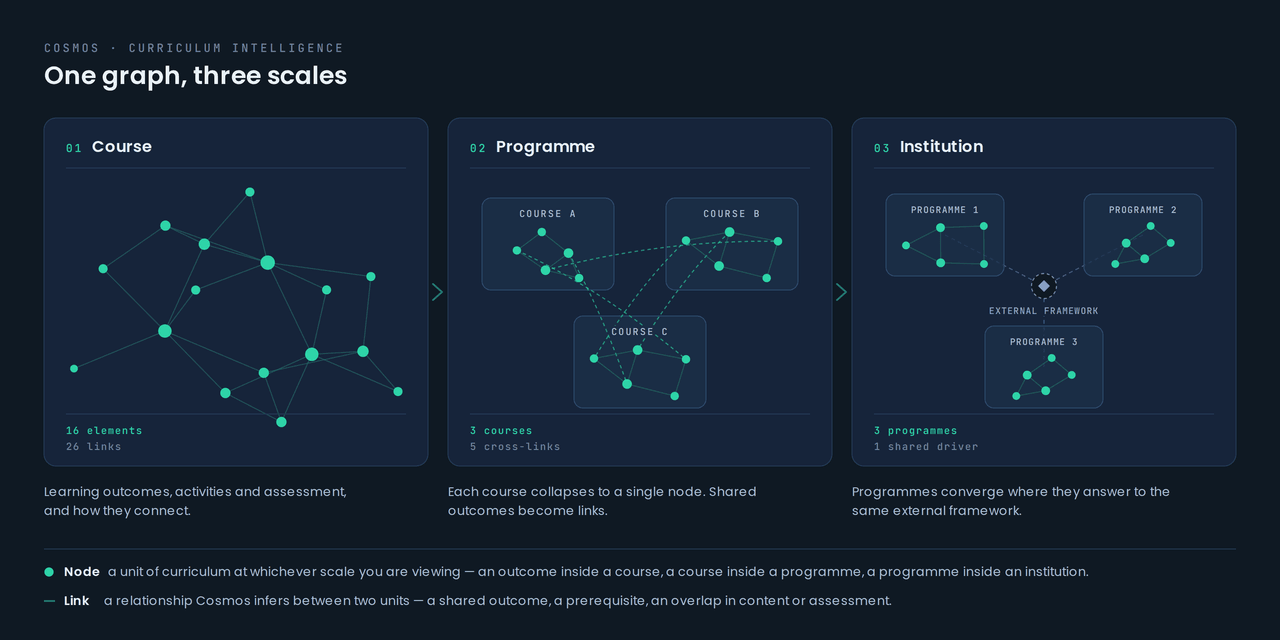
A curriculum is not a collection of documents. It is a network: outcomes, courses, teaching, and assessment, all connected. When a university can finally see that network, the work changes shape:
- Coverage questions get answered in minutes, in meetings, not in a review two years from now.
- Accreditation stops being an event. The evidence exists continuously, because it's generated by the way you work.
- Reform starts from the actual structure of the programme, not from committee recollection of it.
That is what it means to treat curriculum as a living network.
How Cosmos works
From connected curriculum to better decisions
Cosmos turns existing curriculum information into a model teams can explore together, helping them understand what exists, test what could change, and make decisions with traceable evidence.
Understand the current curriculum
Connect courses, learning outcomes, assessment and teaching evidence to see relationships, progression, gaps and dependencies across the programme.
Explore change before implementation
Test proposed changes to courses, outcomes, assessment or programme structure and see how their effects propagate through the wider curriculum.
Decide and document with confidence
Use traceable evidence to support programme review, quality improvement and accreditation, while preserving the basis for decisions over time.
Inside Cosmos
Visibility across curriculum and teaching

Plan your curriculum visually
Drag courses into semesters and watch programme-level analytics update in real time: coverage, outcome exposure, and progression in one view. Planning meetings work from the same living picture instead of competing spreadsheets.
Explore Cosmos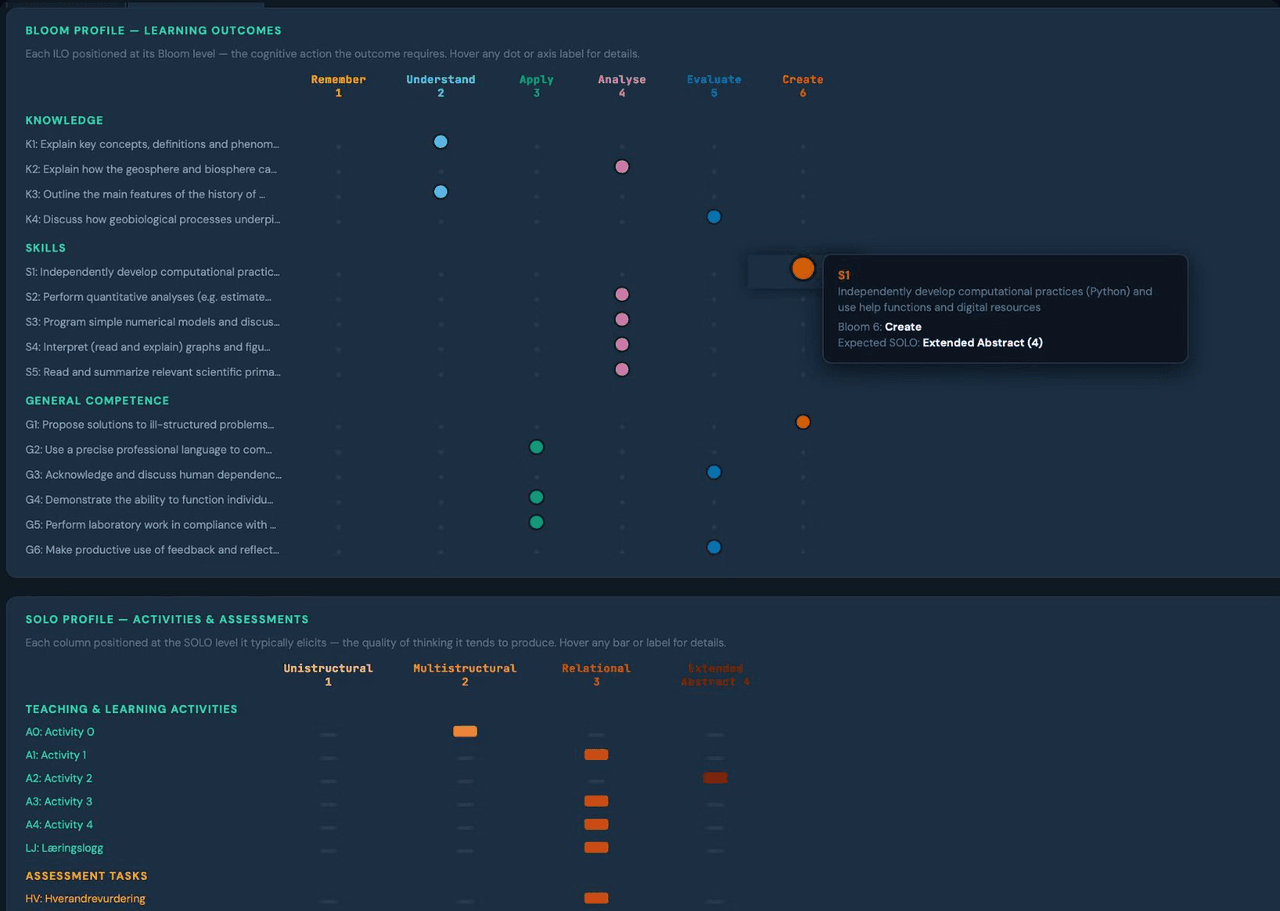
Map learning-outcome coverage
Cosmos maps every outcome against Bloom, SOLO, or the taxonomy your institution already uses, so you see cognitive demand and coverage gaps across a whole programme, and fix them before a review finds them.
See how Cosmos works
Understand alignment, with AI that shows its reasoning
Cosmos scores how well each activity and assessment connects to learning intentions, and explains every score in plain language. AI-powered, not AI-dependent: the platform surfaces structure, your academics decide.
See how Cosmos works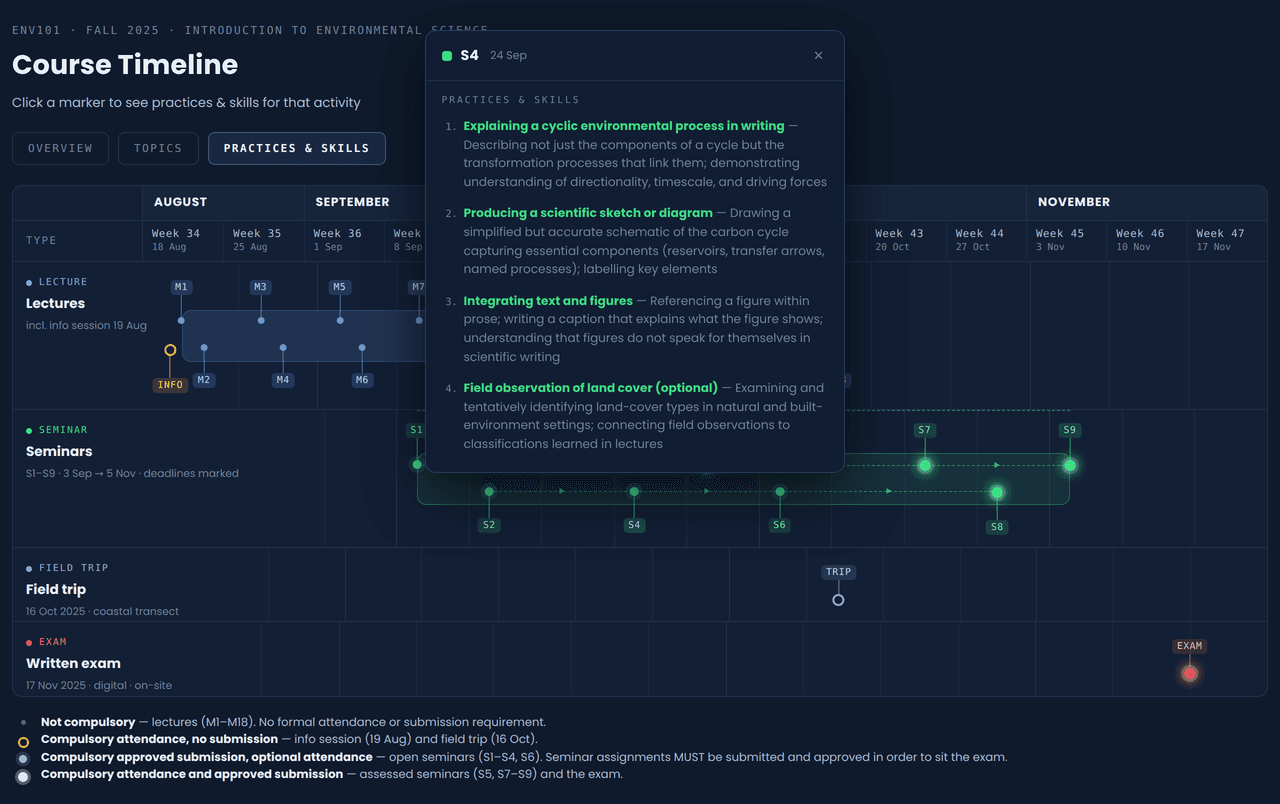
Generate accreditation-ready evidence
Traceability from institutional goals down to course activity means evidence is generated by the way you work, not rebuilt by hand in the weeks before a deadline.
Explore CosmosThe roles responsible for programme quality
Cosmos supports the people accountable for programme quality, learning outcomes, and accreditation readiness.
Programme directors
Understand programme coherence, identify weak links, and improve outcomes across courses.
Quality assurance
Generate traceable evidence for audits and accreditation, without manual reporting cycles.
Deans & leadership
Connect institutional strategy to what happens in teaching practice, at scale.
Teaching teams
Spot learning gaps early and coordinate improvements across courses and semesters.
Research & recognition
Grounded in research, built for practice
Cosmos grew out of eight years of research and development at the University of Bergen, combining curriculum design, learning analytics, and established principles of constructive alignment.

Recognised educational innovation
Developed by a team whose educational work received the National Education Award (2023).
Research-based foundation
Developed from peer-reviewed research in curriculum design and learning analytics.
Academic judgement stays central
Cosmos uses AI-assisted analysis to support curriculum work, while educators retain responsibility for interpretation and decisions.
Questions universities ask us
Cosmos is Cognosic's curriculum-intelligence platform for universities. Most institutions run programme quality on spreadsheets, PDFs, course catalogues, and committee memory. Cosmos replaces that with a connected network: outcomes, courses, teaching activity, and assessment linked together, so programme coherence, learning-outcome coverage, and accreditation evidence are visible continuously instead of rebuilt by hand every review cycle.
They solve different problems. An LMS runs individual courses: content, submissions, grading. Cosmos operates at the programme level: it models the curriculum itself as a network across courses, so you can see how outcomes, assessments, and teaching activity connect to programme- and institution-level goals. The two complement each other; Cosmos gives programme directors and quality-assurance teams a layer of structural visibility an LMS was never built to provide.
Yes. Cosmos maps learning outcomes against Bloom's taxonomy, the SOLO taxonomy, or a taxonomy your institution has already built; it's designed to adapt to the framework you use, not to replace it with a new one.
Cosmos is AI-powered, not AI-dependent. The AI scores how well each activity and assessment connects to your learning outcomes and explains its reasoning in plain language, so academics can see exactly why a score was given. The AI surfaces structure; your teaching teams and QA staff make the judgment calls. Nothing about the scoring is a black box.
Cosmos is built for university governance: multiple stakeholders, existing committee structures, and long institutional memory, not a generic software rollout. Implementation is scoped to your institution's own processes and existing programme structures.
See How we work for what a typical engagement looks like.
Cosmos is priced customer to customer, based on the scope of your institution; there's no public price list or fixed tier.
See Plans for how engagements are structured, or request a demo and we'll work out what fits your programme.
Still have questions?

Ready to see your programmes clearly?
If you're responsible for programme quality, accreditation readiness, or curriculum design, Cosmos gives you visibility across the institution.
A conversation with the team behind the research (no commitment).