
The Cosmos platform
See the whole curriculum at once
Cosmos is a curriculum-intelligence platform that models outcomes, courses, assessment, and teaching activity as one connected system, built on eight years of peer-reviewed research and in production at Norwegian universities.
Cosmos runs on the course descriptions and learning outcomes your staff have already written, with no new data entry.
What Cosmos does
From curriculum intent to educational impact
Cosmos gives universities a shared source of truth across curriculum, teaching activities, and institutional goals, for the people responsible for programme quality, learning outcomes, and accreditation readiness.
Curriculum intelligence
Model outcomes, courses, assessment, and progression as a connected system, and see what's missing.
Curriculum scenario analysis
Test curriculum changes before implementation. Explore their effects across courses, outcomes, assessment, workload, and programme structure.
Teaching practice analytics
Measure what happens in teaching and learning activities, not only what was planned.
Quality and accreditation
Build traceable evidence from strategy to classroom practice, ready for internal QA and external accreditors.
Your curriculum is documented. But can you see the system?
In most universities, the information needed to understand a programme already exists across course descriptions, learning outcomes, assessment plans, spreadsheets, and committee documents.
The challenge is connecting it.
Can you answer, quickly and confidently:
- Where are learning outcomes introduced, reinforced, and assessed, and where are the gaps or unintended overlaps?
- How does what happens in teaching and assessment compare with what the curriculum says should happen?
- If you changed a course, assessment, or learning outcome, what else across the programme would be affected?
- If you needed evidence for programme review or accreditation today, could you produce a current and traceable picture of the curriculum?
Cosmos connects the information you already have into a living model of the curriculum, so these questions can be explored continuously, not reconstructed from scratch each time.
The capability tour
What you can see and do in Cosmos
Five views, one connected model. Everything below runs on the course descriptions and learning outcomes your institution already maintains.
Plan programmes on a live board
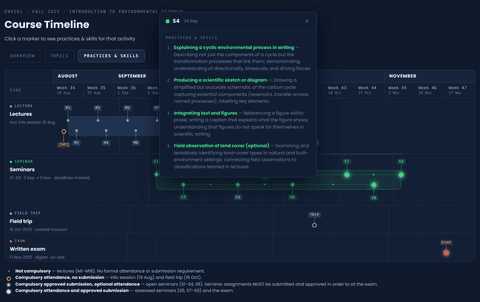
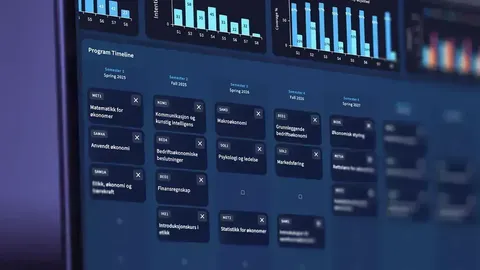
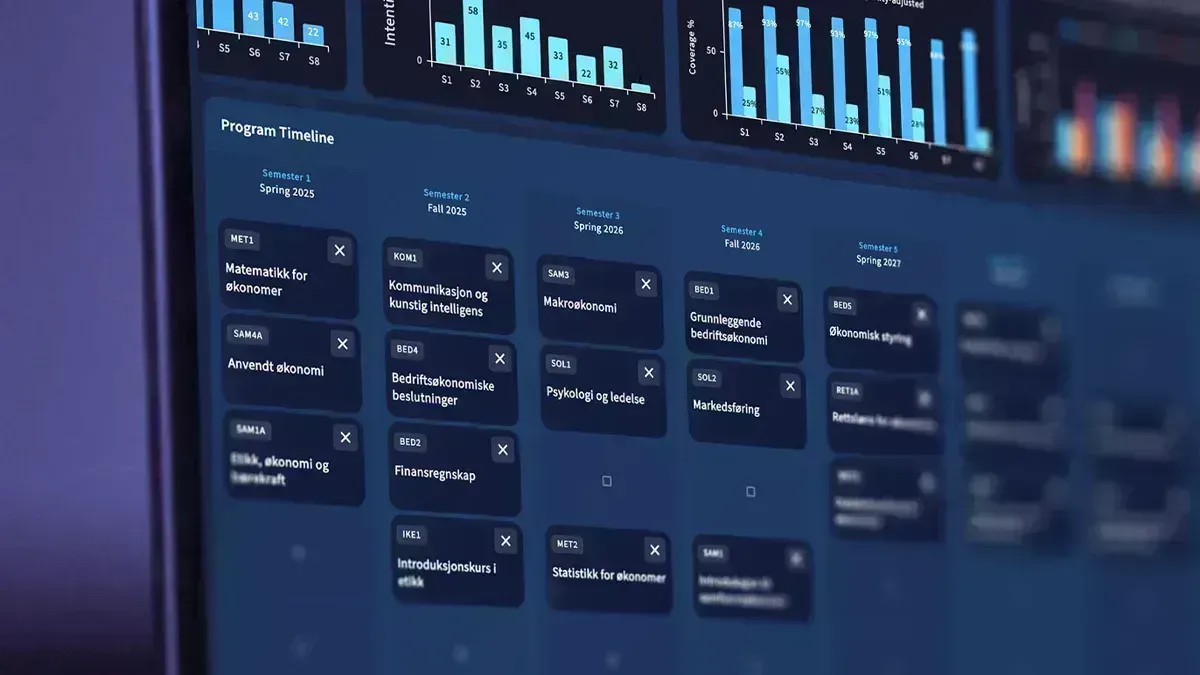
Drag courses into semesters and the programme analytics follow in real time: outcome exposure, coverage, and ECTS progression update as you move things. Planning meetings work from one shared picture, and a proposed change shows its consequences before anyone commits.
Map coverage and cognitive demand
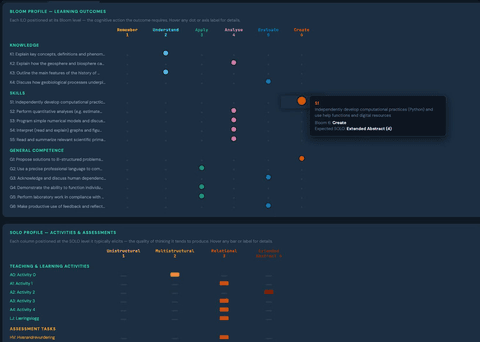
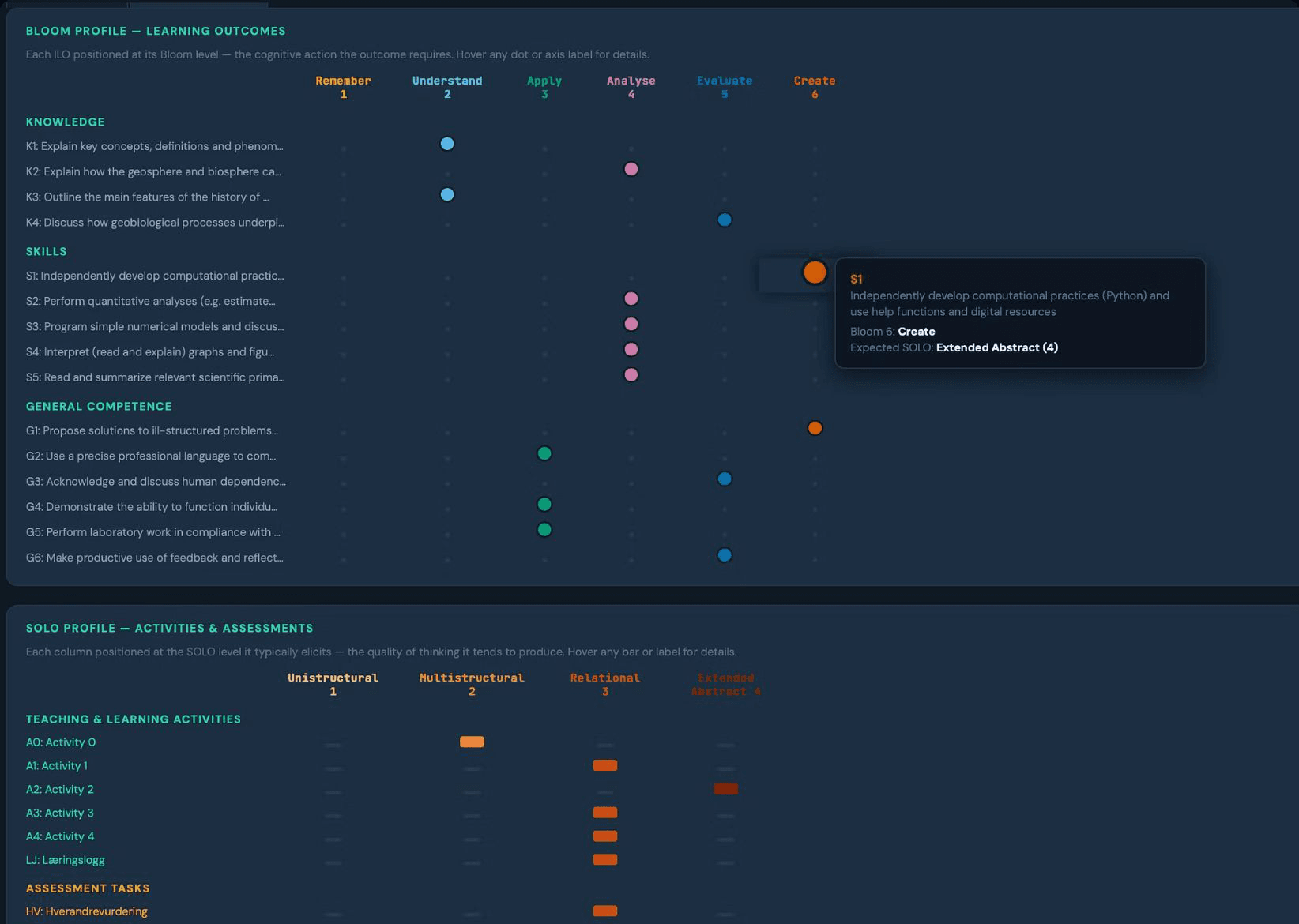
Every outcome is mapped against Bloom, SOLO, or the taxonomy your institution already uses. Cosmos profiles the cognitive demand of outcomes and activities across the whole programme, so gaps and duplicated coverage surface between review cycles, not during one.
See how the model works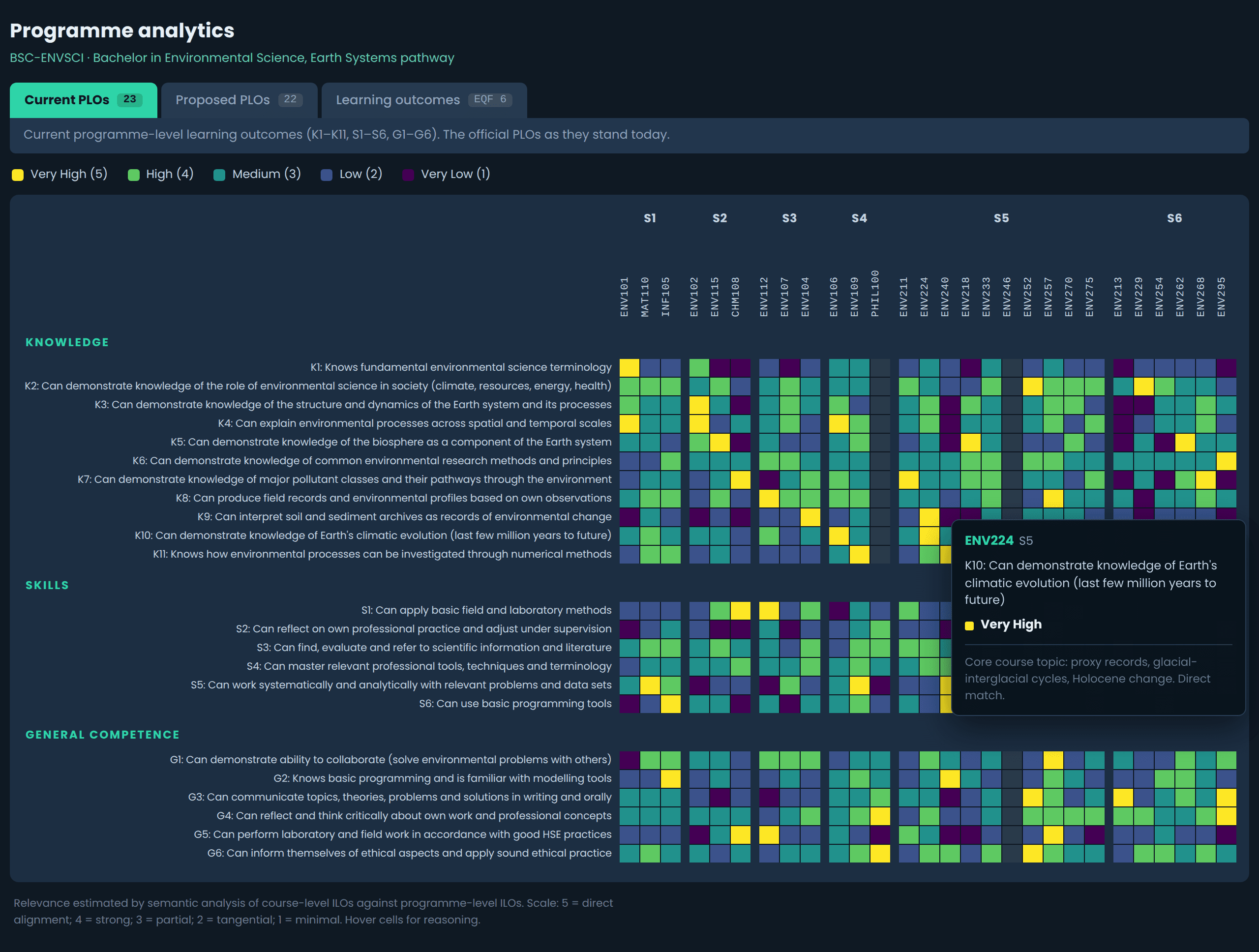
Check coherence with the alignment matrix
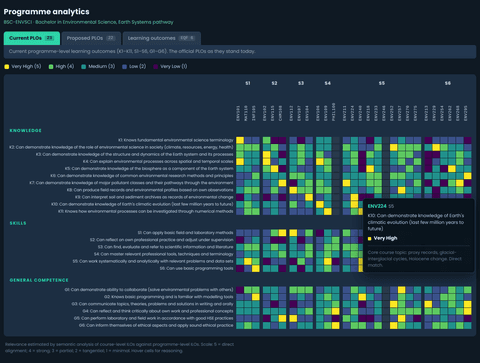
The alignment matrix maps course-level outcomes against programme intentions, course by course. You see exactly how each course carries the programme, and where contribution is thin, redundant, or missing.
Analyze teaching practice: AI that shows its work
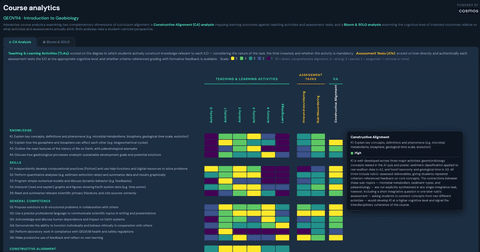
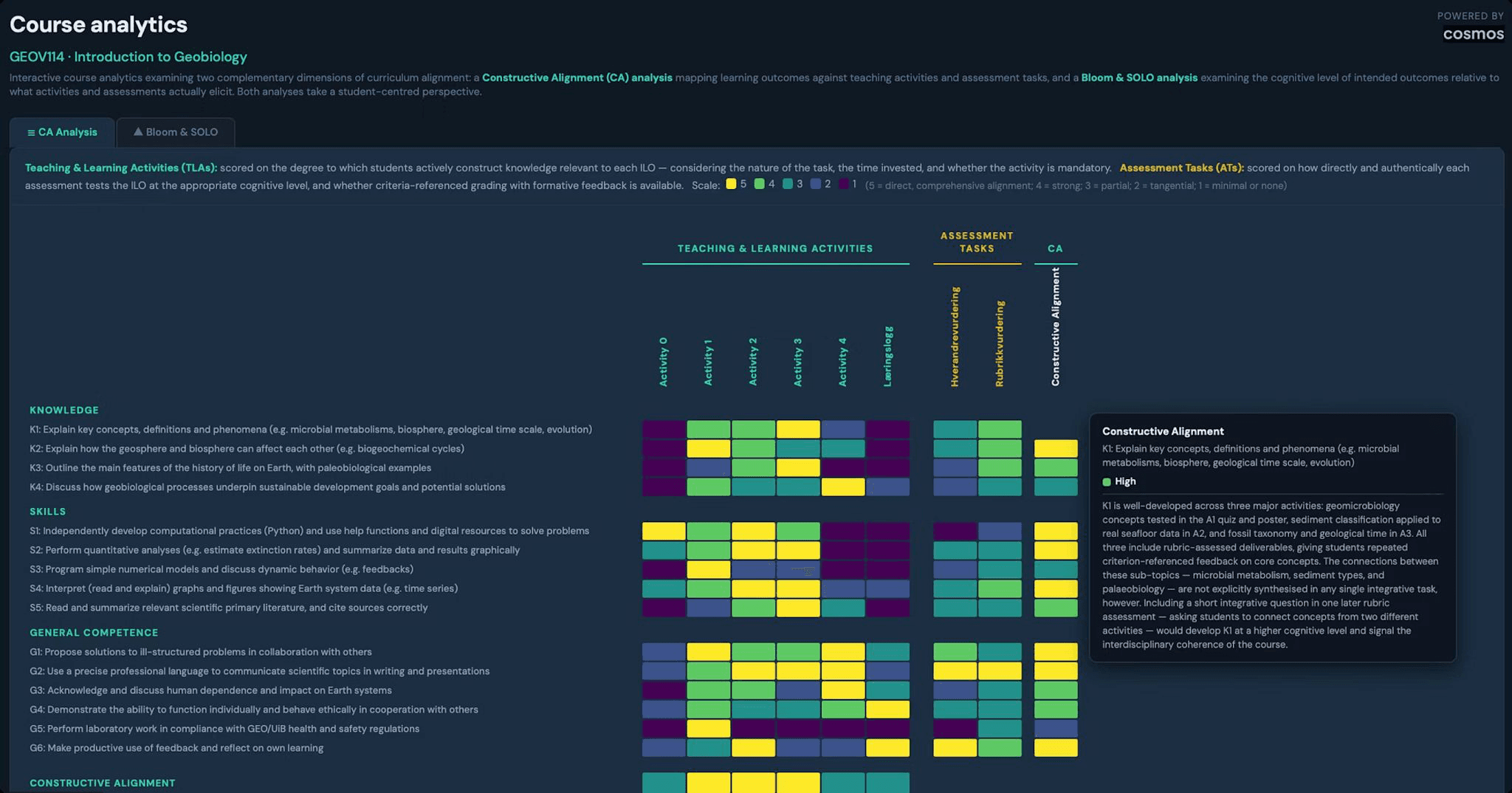
Cosmos evaluates how well tasks and assessments connect to learning intentions, and explains every score in plain language. AI-powered, not AI-dependent: the AI does the reading nobody has time for; your academics keep the judgement.
How the AI shows its reasoning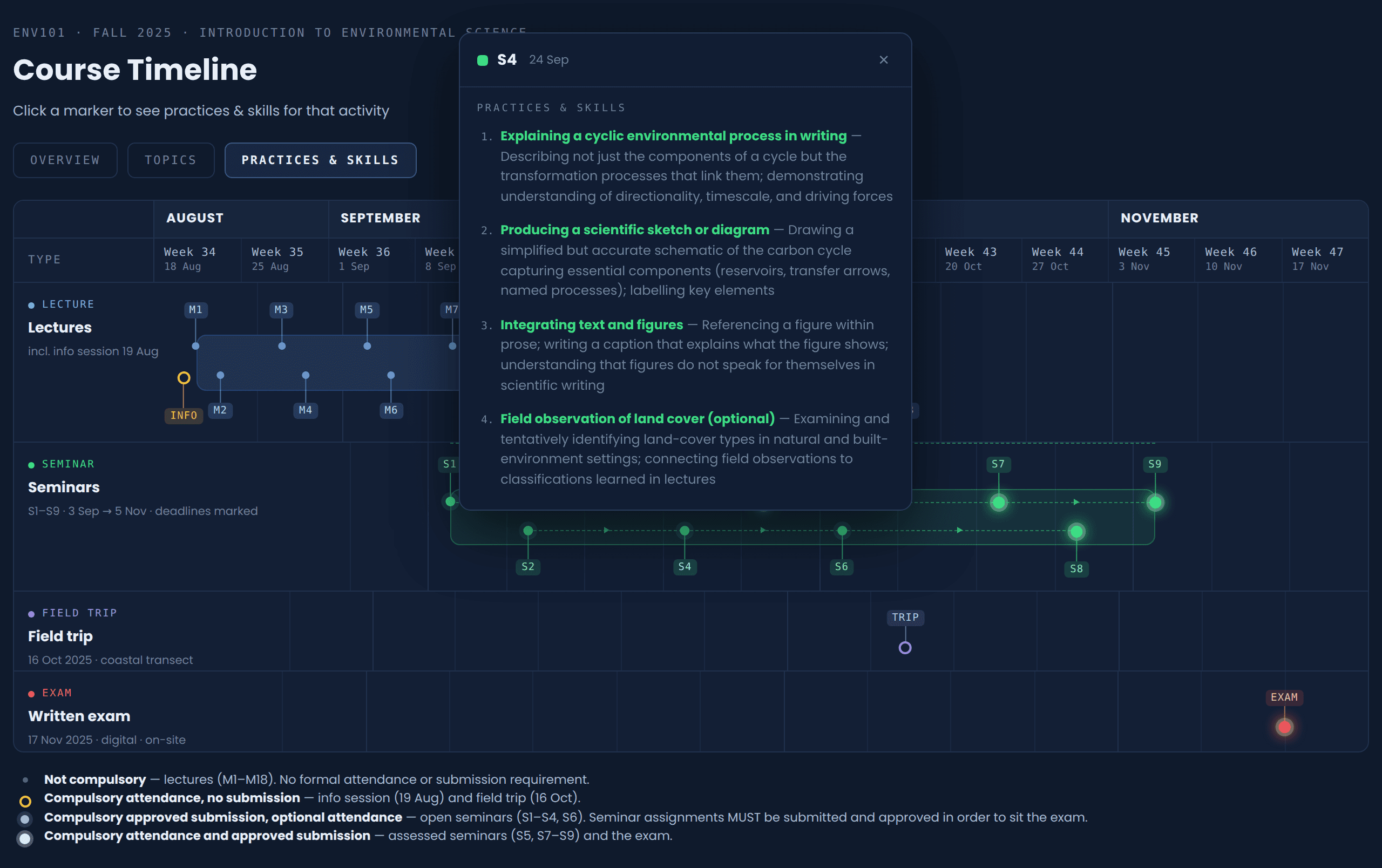
Produce accreditation-ready evidence
Because the model is connected end to end, evidence carries traceability from institutional strategy through outcomes and course design to teaching practice. Documentation is generated by the way you work: defensible, current, and ready when the review arrives.
How Cosmos fits your review cycleAlso in Cosmos
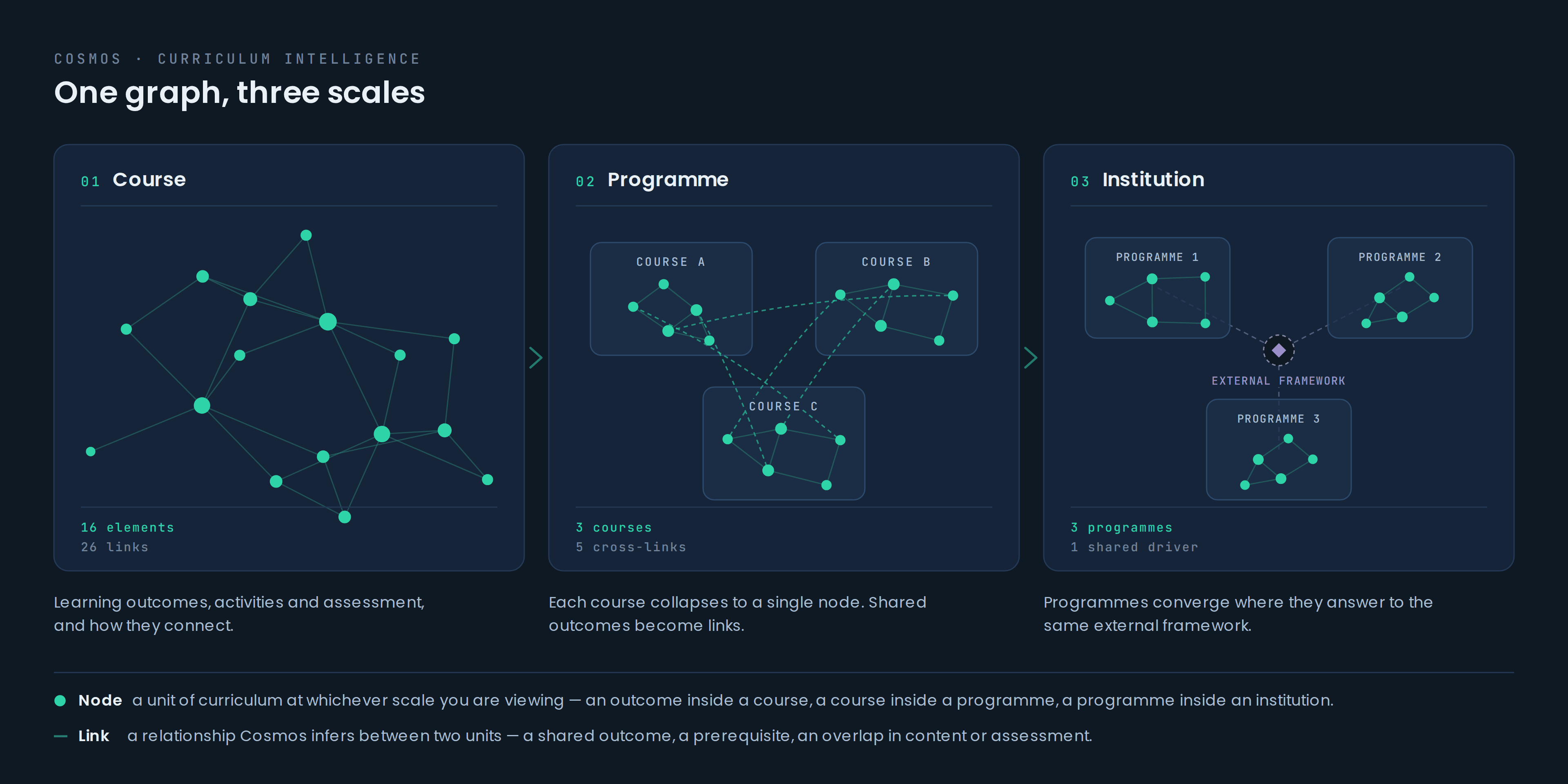
From a single assignment to the whole institution
Multi-level zoom
Navigate from one assignment deadline to full programme structure without losing context.
Virtual experiments
Model moving a course or redesigning an outcome, and see how it affects the programme before making any real change.
Programme assessment
Evaluate entire programmes and identify gaps or redundancies, not just one course at a time.
Real-time quality assurance
Automated quality checks that reduce administrative burden while improving outcomes.
Typical workflows
What universities use Cosmos for
Cosmos is designed to support continuous quality work: these are the workflows institutions run in it.
See where outcomes are covered, where they're missing, and how coverage changes across semesters and programmes.
Understand how courses and assessments contribute to programme-level goals, and where the curriculum breaks.
Generate defensible documentation with traceability from strategy to outcomes to course design to teaching practice.
Turn insights into actions: coordinate teaching teams, track changes, and verify improvement over time.
Why Cosmos
Built for the layer your other systems don't see
Not another LMS
Your LMS runs courses: delivery, submissions, grades. Cosmos models the curriculum across courses, outcomes, alignment, and evidence at programme level. Keep your LMS; Cosmos works above it.
Not another spreadsheet
Spreadsheets can work well for a one-time mapping exercise. They become harder to maintain when relationships span courses, programmes, frameworks and review cycles. Cosmos keeps those relationships connected so analyses update as the underlying model changes.
AI with evidence, not AI as authority
Cosmos uses AI to support classification and analysis at scale, but pedagogical judgement stays with academic teams. Analyses are grounded in explicit educational criteria, accompanied by interpretable reasoning, and linked back to the evidence used to produce them.
What evaluation teams ask about Cosmos
Cosmos models outcomes, courses, assessment, and teaching activity as one connected system. It gives programme teams visual curriculum planning, outcome coverage mapping, transparent AI alignment analysis, and accreditation-ready evidence, continuously, not just at review time.
No. Your LMS runs course delivery: content, submissions, grades. Cosmos models the curriculum across courses: outcomes, alignment, and evidence at programme level. The two systems complement each other; most institutions run both.
Cosmos is designed to minimise manual reconstruction. It can build from curriculum documentation your institution already maintains, while designated academic or quality-assurance users review and validate mappings where necessary.
Yes. Cosmos maps outcomes against Bloom's taxonomy, the SOLO taxonomy, or your institution's own framework.
Cosmos scores how well tasks and assessments align with learning outcomes, and explains every score in plain language, so academics can see the reasoning rather than trust a black box. It surfaces structure at scale; your academics keep the judgement. Cosmos is AI-powered, not AI-dependent.
Cosmos is built to be GDPR-aligned and hosted within institutional or EU infrastructure. It analyzes programme structure, not individual student behaviour or performance, and every output is traceable and documented.
Pricing is scoped per institution rather than published as a fixed price list. See the Plans page for how pricing works, or get in touch and we'll talk through what fits your institution.
Yes. Cosmos is designed to preserve the connection between analytical results and the curriculum evidence that supports them, so users can inspect the basis for a conclusion rather than rely only on an AI-generated score.
Yes. Scenario analysis allows teams to explore proposed changes separately and examine their effects across connected courses, outcomes, assessments and programme structures before deciding whether to implement them.
Want to see it on your own programmes?

See it on your own curriculum
Bring us a programme question. We'll show how Cosmos connects your curriculum evidence, reveals alignment and progression, and explores the impact of potential changes across the programme.
Won by the founding team: the National Education Award (2023).